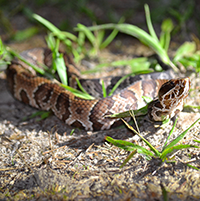
Snakes are a natural part of South Carolina’s landscape and often go unnoticed as they move quietly through yards and gardens. They help control rodent and insect populations and typically avoid human interaction whenever possible. While not everyone is comfortable seeing a snake, understanding their role in the ecosystem can help foster coexistence and a healthier balance in your outdoor space.
Credit: Zach Steinhauser
Description
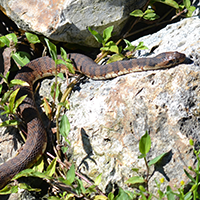
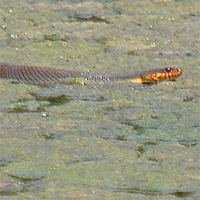
Banded watersnakes are mid-sized, 24–48 in (61–106.7 cm), fairly heavy-bodied semi-aquatic snakes. Coloration is variable, with snakes ranging from light brown or reddish to black in ground color with darker crossbands. Crossbands are larger on the middle of the back and narrower on the sides, unlike the hourglass-shaped bands of copperheads, Agkistrodon contortrix. Crossbands may be obscured as the snake darkens with age, and some individuals appear uniformly dark. In addition to crossbands, there are squarish spots at the sides of the belly and a dark stripe from the eye to the angle of the jaw.
Habitat
Banded watersnakes are commonly seen near many aquatic habitats and are active both day and night. They may be seen basking on logs or branches overhanging the water or foraging in shallow water for fish and amphibians, their principal prey. Watersnakes are viviparous, giving birth to 15–20 young in late July or August.
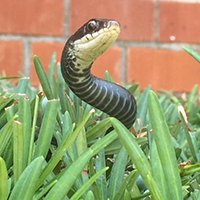
As their name implies, black racers are relatively large, up to 60 in (152 cm), fairly slender, solid black snakes. They have smooth scales, large eyes, and often show some white coloration under the chin. The belly is uniformly dark gray or black. Adult racers can be mistaken for other large black snakes in the region, including black rat snakes, black-phase eastern hognose snakes, eastern or black kingsnakes, or dark coachwhips. However, black racers are more slender and uniformly black than these species. They also lack the upturned nose of hognose snakes and the keeled scales of hognose and rat snakes. From a distance, behavior is often the best way to identify a racer. While rat snakes, kingsnakes, and hognose snakes tend to freeze when approached, racers usually flee rapidly or sometimes stand their ground and attempt to strike.
Habitat
Black racers are active only during the daytime and are most active in warm weather. At night and during cool weather, they take refuge in burrows or under cover such as boards or tin. Racers hunt by sight and are often observed actively foraging during the day. They eat a wide variety of prey including insects, lizards, snakes, birds, rodents, and amphibians. In turn, they are preyed upon by various predatory birds, mammals, and snakes such as kingsnakes and larger racers. Prey is not constricted and is consumed alive. Racers are faster than most other snakes, very agile, and typically flee when approached, often climbing into small trees or shrubs. If cornered, however, they will bite. Although primarily terrestrial, they climb well and are sometimes observed sleeping in vegetation at night. Racers mate in spring, and females lay up to 36 eggs in early summer. Eggs hatch in late summer or early fall.
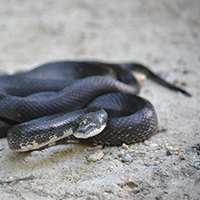
Adult rat snakes are typically 3–5 ft (91–152 cm), but large individuals may exceed 6 ft (183 cm) in length. Their appearance varies greatly across their geographic range. Black rat snakes are more northern in distribution and are characteristically black on top with faint hints of white between some scales. Yellow rat snakes are greenish, yellow, or orange with four dark stripes running the length of the body. Gray rat snakes range from dark to light gray with darker gray or brown blotches. Juveniles of all subspecies resemble gray ratsnakes. The belly is whitish near the head and becomes checkered or mottled toward the tail. The body cross section is loaf-shaped rather than round. Rat snakes have weakly keeled scales, and the anal plate is divided.
Habitat
Adult rat snakes primarily eat mice, rats, squirrels, and birds, as well as bird eggs, and are common predators of wood duck eggs. Juveniles eat small frogs, lizards, and small rodents. Rat snakes are constrictors and skilled climbers capable of scaling brick walls and tree trunks. When frightened, they often assume a kinked posture and remain motionless. They may vibrate their tails and expel a malodorous musk.
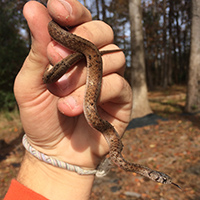
Brown snakes are small, 6–13 in (17–33 cm), and are usually brown but can be yellowish, reddish, or grayish-brown. They typically have two rows of dark spots, sometimes linked, along the back and a dark streak down the side of the head. The belly is light brown to white, often with a series of tiny black dots along each side. Young snakes have a yellowish collar extending down the neck with a less evident dorsal pattern. Brown snakes resemble earth snakes (Virginia sp.), but those species lack spots on the back and head.
Habitat
Brown snakes hide under cover such as leaf litter and logs, but are sometimes active in the evening or at night and may be seen crossing roads. They feed almost exclusively on soft-bodied invertebrates such as slugs and earthworms. Brown snakes are viviparous, with females giving birth to 3–31 young in late summer. They likely reach sexual maturity at 2–3 years of age.
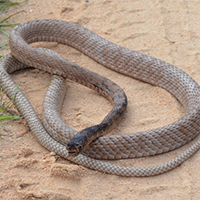
Although fairly slender, coachwhips are among the longest snakes in the region, reaching over 8 feet (244 cm). Their coloration is distinctive, fading gradually from black on the head to tan or nearly white on the tail. The proportion of black to tan varies across the region, and individuals in southern Georgia and Florida can be nearly completely tan. The pattern of scales on the tail resembles a braided whip, giving the snake its common name. Young coachwhips are very slender and completely tan with irregular darker bands and white markings on the head and neck. Coachwhips have large eyes and excellent vision.
Habitat
Coachwhips are active only during the daytime and are most commonly seen in hot weather, often during the hottest summer conditions when other snakes are inactive. At night and during cooler weather, they take refuge in burrows or under cover such as boards or tin. Coachwhips hunt by sight and actively pursue prey, often with their head held high above the ground. Their diet includes a wide variety of prey such as insects, amphibians, lizards, snakes, birds, and rodents. In many areas, lizards are particularly important prey, and coachwhips are capable of chasing down race runners and skinks.
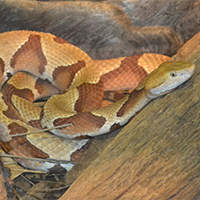
Copperheads are fairly large, 24–40 in (61–102 cm), heavy-bodied snakes with large, triangular heads and elliptical pupils (cat-like eyes). The body is tan to brown with darker, hourglass-shaped crossbands running down the length of the body. Individuals from the Coastal Plain often have crossbands that are broken along the center of the back. The head is solid brown, with two tiny dots located in the center of the top of the head. Juveniles resemble adults but have a bright yellow tail tip. As pit vipers, copperheads possess facial pits that sense heat and are used to detect prey and predators. Male copperheads are larger than females. Many harmless species are confused with copperheads, but they are the only snakes in the region with hourglass-shaped crossbands; other species have blotches that are circular, square, or widest at the center of the back.
Habitat
Copperheads may be found during the day or night but forage primarily after dark during hotter parts of the season. In the Piedmont and Coastal Plain, they are frequently observed crossing roads on warm nights. In mountainous regions, copperheads are often found during the day basking on rock outcrops or coiled in ambush positions. They are opportunistic feeders and consume a wide variety of prey, including amphibians, lizards, snakes, small mammals, birds, and insects. Copperheads mate in the spring, during which males travel long distances in search of females. Although venomous, copperhead venom is relatively mild, and deaths from copperhead bites are extremely rare. Most bites occur when people attempt to kill or harass snakes, so the best way to avoid a bite is to leave any snake alone.
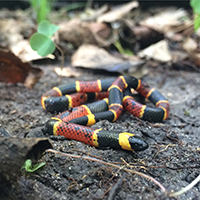
Adult eastern coral snakes are slender, medium-sized snakes measuring 18–30 in (46–76 cm), though some individuals may reach nearly 4 feet (122 cm) in length. They have smooth scales, and the anal plate is usually divided. Their most distinctive feature is the bold pattern of red, yellow, and black rings, with the red and yellow rings touching each other. The nose is black. Scarlet kingsnakes (Lampropeltis triangulum elapsoides) and scarlet snakes (Cemophora coccinea) appear similar but can be distinguished because their red bands touch only black bands, not yellow. The eastern coral snake is the only snake species in the eastern United States with a pair of fixed fangs located at the front of the mouth.
Habitat
Coral snakes are rarely observed throughout most of their range, largely due to their secretive nature and tendency to spend much of their time underground. They generally do not climb trees or shrubs and spend limited time moving above ground. Most sightings occur during spring and fall. When threatened, coral snakes often elevate and curl the tip of their tail as a defensive display. They primarily prey on other snakes and lizards, which they kill by injecting venom. Eastern coral snakes typically lay six to seven eggs in early summer, with young hatching in late summer or early fall. Despite their elusive behavior, coral snakes can persist in suburban areas.
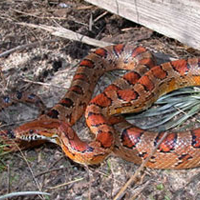
A fairly large — 76-122 cm (30 – 48 in) — relatively slender snake that is orange, reddish brown, brown, or gray with 27-40 squarish black-margined brown or reddish blotches. The belly is checkered with white and black markings, resembling a piano keyboard or Indian corn. Other distinguishing characteristics include a spear-shaped blotch on top of the head, pointing toward the nose, black stripes on either side of the bottom of the tail, smooth scales, and a stripe extending from the back of the eye past the corner of the jaw. Corn snakes are often mistaken for venomous copperheads. Copperheads, however, have hourglass-shaped (rather than square) blotches, and are generally browner than corn snakes.
Habitat
Corn snakes spend most of their time underground or hidden under objects such as logs, boards, or pieces of roofing tin. They climb well and young ones are often found hiding under tree bark or climbing in brush. Corn snakes are active both day and night, but become primarily nocturnal in the warm summer months. They eat a variety of mammals, birds, and reptiles, and young snakes are particularly fond of lizards. Corn snakes lay large clutches of oval eggs in the spring in rotten logs or other warm, moist places.
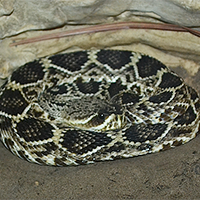
The eastern diamondback rattlesnake is the largest of the 32 species of rattlesnake currently recognized. They are large, heavy-bodied snakes with large, broad heads with two light lines on the face. Adults are usually 33-72 in (84-183 cm) long, but the largest individual on record was 96 in (244 cm). Mature snakes can tip the scales at over 10 lbs. The background color is brown, tan, or yellowish and covered with the namesake diamonds, which are brown and surrounded by lighter scales. Males are larger than females.
Habitat
Like most large pitvipers eastern diamondbacks spend most of their time coiled in palmetto thickets or other thick vegetation to ambush prey. Most movement between locations occurs during the day and is mostly restricted to the morning and evening in summer. Diamondbacks spend the winter in stump holes or tortoise burrows but may emerge on warm winter days to bask. This species feeds almost exclusively on mammals, particularly rabbits. Mating occurs in the spring and fall, and females give birth to 12 – 24 young in the late summer. Diamondbacks grow slowly, taking several years to reach maturity, and adult females only reproduce every 2-3 years.
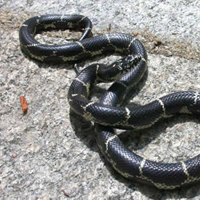
Eastern kingsnakes are large, 36 – 48 in (90-122 cm), shiny-black, smooth-scaled snakes with white or yellow chain-link bands that cross the back and connect along the sides. Because of this pattern, this species is also referred to as the chain kingsnake. Generally, individuals from the Coastal Plain have wide bands while those from the mountains may have very thin bands or be nearly completely black. Eastern kingsnakes have a short stout head and small beady eyes. They have an undivided anal plate.
Habitat
In our region kingsnakes are active almost exclusively by day but are most active in the morning during the summer. They are strong constrictors and consume a variety of prey including snakes, lizards, rodents, birds, and especially turtle eggs. Kingsnakes are resistant to the venom of pit-vipers, and they readily eat copperheads, cottonmouths, and rattlesnakes. Although they frequently rattle their tail, release musk, and bite upon capture, they tame quickly and are often kept as pets. This species mates in the spring and males bite the neck of females while mating. Females lay 3-24 eggs under debris or in rotting logs in early summer and eggs hatch in August-September.
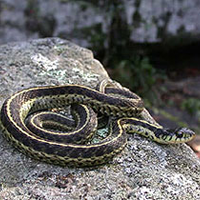
Thamnophis sirtalis is usually 18 – 26 in (45.7 – 66 cm) long, but occasionally reaches lengths up to 49 in (124 cm). Most individuals can be distinguished from other species by the presence of three yellow longitudinal stripes down a dark body. Some, however, exhibit a checkered body pattern with light stripes and a grayish or reddish body color. Additionally, in garter snakes, the lateral yellow lines are on scales 2 and 3 whereas they are on scale rows 3 and 4 in ribbon snakes. On garter snakes, they are on scales 2 and 3. Males have longer and thicker tails than females.
Habitat
Garter snakes may be active by day or night and are often found under boards or other debris. They are viviparous (give birth to live young) and sometimes have more than 50 babies. Common garter snakes feed on worms, slugs, frogs, toads, salamanders, fish and tadpoles. They may be active throughout the year, including warm winter days.
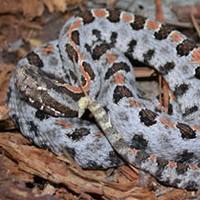
This small — 14–22 in (38-56 cm) — rattlesnake belongs to the genus Sistrurus and is commonly referred to as a pigmy rattler or ground rattler. Unlike the larger rattlesnakes of the genus Crotalus, this species has nine large scales on top of the head and a tiny rattle that can seldom be heard. There are three subspecies of pigmy rattlesnakes, of which two occur in Georgia (Sistrurus miliarius miliarius – the Carolina pigmy rattler and Sistrurus miliarius barbouri – the dusky pigmy rattler). Both subspecies have a row of mid-dorsal spots and a bar than runs from the eye to the base of the mouth, but the color of this bar can vary from black to brownish red. An orange or reddish brown dorsal stripe is also present on both subspecies. In young snakes, the tip of the tail is sulfur yellow and is used for caudal luring. The Carolina pigmy rattler can be gray, tan, or lavender.
Habitat
Pigmy rattlesnakes spend most of their time well-hidden among leaf litter and can be very hard to spot. From such hiding places, they ambush a variety of prey including lizards, frogs, small mammals, and insects as well as centipedes. These snakes are most often encountered crossing roads on summer evenings. Females give birth to live young in the late summer or fall.
The redbellied snake is a small woodland snake, ranging from 4 – 10 in (10 – 25 cm) long. This species is one of our most variably-colored snakes, with some individuals ranging from bright orange to brown, gray, or nearly black. Occasionally individuals are found that are gray with a brown or orange stripe down the center of the back. Many individuals have a light brown ring behind the head. This species can easily be distinguished from all other small woodland snakes by their unmarked, bright orange to the red underside.
Habitat
Redbellied snakes are generally very secretive and can be found hiding under logs, rocks, and leaf piles. They feed nearly exclusively on slugs. Redbellied snakes breed in the spring or fall, and females give birth to 4 – 9 (but up to 23) young, in summer. They probably reach sexual maturity within 3 years. Research at the Savannah River Ecology Lab has shown that this species tracks the changing boundaries of wetlands as they fill and dry, probably following areas where the most slugs are found. When threatened this species rarely bites but adopts a bizarre lip-curling behavior.
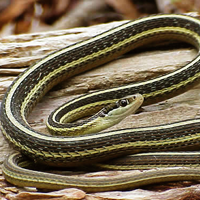
Ribbon snakes are slender snakes that range from 16-28 in. (41-71 cm) long. They have three light, usually yellow, stripes (two along the sides and one down the center of the back) against a dark background. Between the yellow lateral stripes and the belly, there is a brown lateral stripe. Ribbon snakes resemble the closely-related eastern garter snake (Thamnophis sirtalis), however, ribbon snakes are more slender, have unpatterned lip scales, and the lateral stripes are found on scale rows 3 and 4 (in garter snakes they are on rows 2 and 3).
Habitat
Ribbon snakes eat small fish and amphibians and often swim in the water near the shoreline. After reproduction, the male inserts a copulatory plug to prevent other males from mating with that particular female. Ribbon snakes are viviparous, with females giving birth to live young in the late summer.
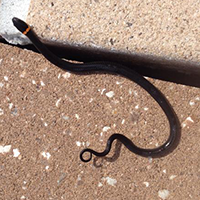
Ringneck snakes are small, 10 – 15 in (25 – 38 cm), slender snakes that are generally grayish with a yellow or orange band around the back of the neck and a yellow or orange underside. Two subspecies are found in our region. The northern ringneck snake (Diadophis punctatus edwardsi) inhabits the mountains and generally has a complete neck ring and unpatterned underside. The southern ringneck (D. p. punctatus) is found in the Coastal Plain and often has a broken neck ring and underside that is marked with a single row or black spots. The northern ringneck is also generally larger than the southern. Although usually grayish in coloration, both subspecies may range from nearly black to tan and both have smooth scales and round pupils. Females are larger and have proportionally shorter tails than males.
Habitat
Like other small woodland snakes in the Southeast, ringneck snakes spend most of their time underground or hidden under logs, rocks, leaf litter, or debris. However, ringnecks can occasionally be found crawling in the open or crossing roads, often at night. Ringnecks are one of the more common species in many habitats in the Southeast and in other parts of their range can reach extraordinary densities.
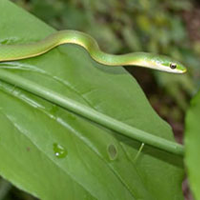
Rough Green Snakes are fairly long – to 32 in (81 cm) – slender, bright green snakes with yellow or whitish bellies that spend much of their time climbing in vegetation. Their bright green color easily distinguishes them from all other snakes in Georgia and South Carolina, but the similar Smooth Green Snake replaces this species in the Appalachian Mountains and the Northeast. Rough Green Snakes have keeled scales and large eyes. After death the color of green snakes fades to blue or black and dead individuals may resemble small black racers. Young Green Snakes resemble adults.
Habitat
Rough Green Snakes are probably the most arboreal snakes in our region and spend the majority of their time hunting for insects, spiders, and other invertebrates in vegetation well above the ground. When encountered, green snakes often freeze, relying on their green coloration for camouflage. At night, Green Snakes can often be found sleeping coiled in shrubs, vine tangles, or thick vegetation. During cool weather Green Snakes often take refuge on the ground and can sometimes be found hiding beneath logs, rocks, or debris. They mate in the spring and females lay 3 – 12 eggs in the early summer.
Scarlet snakes are fairly small — to 20 in (51 cm) — relatively slender snakes that are patterned with alternating red, black, and white or yellow bands. Scarlet snakes are one of the three “tricolored” snakes in our region and, like the harmless scarlet kingsnake, have red bands that do not touch yellow bands. However, this species can be distinguished from the scarlet kingsnake because the kingsnake’s bands completely or nearly completely encircle the body while the bands of the scarlet snake do not extend onto the venter, leaving the underside solid white, pink, or grayish. The venomous eastern coral snake has a black snout and red bands that touch yellow ones. Scarlet snakes have a snout that is pointed and red and red bands that are wider than bands of other colors. Young resemble adults.
Habitat
Like many of the small fossorial snakes in our region, scarlet snakes spend most of their lives underground and are most frequently encountered hiding beneath logs, rocks, leaf-litter, or debris such as boards, tin, or trash. Scarlet snakes are never active above ground during the day: however, at night scarlet snakes do move above ground and are often encountered crossing rural roads on hot summer nights. Scarlet snakes feed primarily on eggs of other reptiles and have enlarged teeth that they use to open eggs that are too large to swallow whole. They also occasionally consume small lizards, snakes, and frogs. Little is known about the reproductive biology of this species, but females are known to lay 2 – 9 eggs in the early summer.
Timber rattlesnakes, which are called canebrake rattlesnake in the Coastal Plain of the Southeast, are large, heavy-bodied snakes with the characteristic rattles on the end of the tail. Adults range from 30-60 in (76-152 cm) with the record being more than 6 feet (183 cm) long. Canebrakes are usually gray and may even have a pink hue and a pinkish, yellow, orange, or brown stripe running the length of the back. Timber Rattlers are typically more brown or yellowish and may even be black. Both forms have solid black tails that appear almost velvet and black chevrons on the back and sides with the point of the (V) pointing forward. The babies are miniatures of the adults but are usually a lighter gray and have only a single button (rattle) on the tip of the tail at birth. Males get larger than females.
Habitat
Timber and canebrake rattlesnakes become active above ground by late spring and can be seen periodically until the onset of cold weather in late fall. Canebrakes are active during both day and night but spend the majority of their time coiled in ambush positions ready to capture prey.
Cottonmouths are venomous semi-aquatic snakes often referred to as “water moccasins.” They have large, triangular heads with a dark line through the eye, elliptical pupils, and large jowls due to the venom glands. They are large – typically 24 – 48 in (61 – 122 cm), occasionally larger, keeled-scaled, heavy-bodied snakes. Their coloration is highly variable: they can be beautifully marked with dark crossbands on a brown and yellow ground color or completely brown or black. Older adults are often dark and solid-colored whereas the juveniles are brightly patterned with a sulphur yellow tail tip that they wiggle to attract prey. The belly typically has dark and brownish-yellow blotches with the underside of the tail being black. As pit-vipers, they have facial pits that sense heat and are used to detect prey and predators. Male cottonmouths are larger than females.
Habitat
Cottonmouths can be found during the day or night, but forage primarily after dark during the hotter parts of the season. Throughout much of their range, they can be found year-round, even in sunny days in the winter. Cottonmouths bask on logs, rocks, or branches at the water’s edge but seldom climb high in trees (unlike many of the nonvenomous watersnakes which commonly bask on branches several feet above the water). They employ both ambush and active foraging strategies. Cottonmouths are opportunistic feeders and are known to consume a variety of aquatic and terrestrial prey, including amphibians, lizards, snakes (including smaller cottonmouths), small turtles, baby alligators, mammals, birds, and especially fish. Cottonmouths mate in the early summer at which time male-to-male combat occurs in competition for females.